Created:
December 4, 2025
Identifying the Moor Frog: How eDNA Adds Certainty to Ecological Surveys
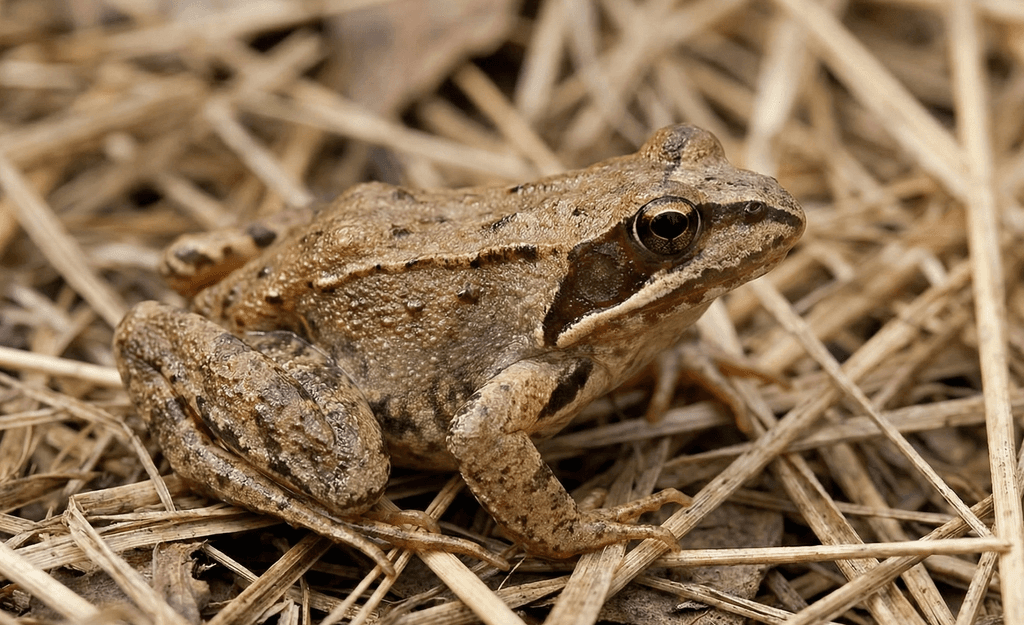
Biological surveys for land use planning and construction projects require precision. One of the most challenging species to survey is the Moor Frog (Rana arvalis), which is strictly protected under the EU Habitats Directive.
As an Annex IV (a) species, the deterioration or destruction of the Moor Frog’s breeding sites and resting places is strictly prohibited. Consequently, verifying its presence or absence is a critical part of any Environmental Impact Assessment (EIA). However, identifying the species reliably in field conditions is not always straightforward.
Modern technology offers a solution. eDNA analysis (environmental DNA) has emerged alongside traditional methods as a powerful tool that helps confirm the presence of the species, even in challenging environments.
Why is the Moor Frog a Challenge for Traditional Surveys?
Even experienced environmental consultants know that amphibian surveys are highly sensitive to conditions.
Similarity to the Common Frog: The Moor Frog is visually very similar to the Common Frog (Rana temporaria). Although experienced herpetologists can distinguish between the two, visual identification can remain uncertain in low light or rapid encounters without handling the animal.
Short Breeding Season: Traditional mapping is often based on listening to the mating calls of males. The "bubbling" call of the Moor Frog is only audible for a short period in the spring, and the frogs may fall silent quickly if the weather changes.
Weather Dependence: If the weather is too cold or windy on the scheduled survey night, observations may be missed even if the species is present in the area.
These factors create uncertainty: is the species truly absent, or was it simply not detected?
eDNA Complements and Verifies Observations
eDNA should not be seen as a replacement for traditional fieldwork, but rather as a method that sharpens it. The technique is based on water samples from which species-specific DNA traces are analyzed.
What benefits does eDNA bring to the survey process?
Wider Time Window: DNA remains detectable in the water longer than the frogs' vocal breeding season lasts. This provides much-needed flexibility for scheduling sampling and reduces the pressure caused by unpredictable weather.
Cost-Effective Screening: eDNA serves as an excellent screening tool. If no Moor Frog DNA is found in the water samples, it can be assumed with a higher probability that the area is not a significant breeding site. Conversely, a positive result helps target more detailed field research and conservation measures to the correct ponds.
More Reliable Outcomes for the Project
For the client, whether a municipality, environmental consulting company, or environmental authority, the reliability of the survey is paramount.
Using eDNA as part of an ecological survey reduces the risk of an Annex IV species going unnoticed. This brings legal certainty to planning processes and prevents unpleasant surprises during the construction phase. The method is also non-invasive, as it does not require catching or disturbing the animals.
Let's Plan the Right Survey Package
The best results are often achieved by combining expert field knowledge with modern laboratory technology.
Do you have an upcoming project where the presence of the Moor Frog needs to be investigated? Contact us, and let's see how our eDNA services can support your biological survey and bring the necessary certainty to your project.
Contact us